


November 4, 2026
Have you ever wondered what happens if you forget to add salt to your pizza dough? You already know the pizza will be bland. The great thing is, you can tell hours before you taste it. Your hands give you the first clue, the box of dough balls gives you the second.
In this article
What changes under your hands?
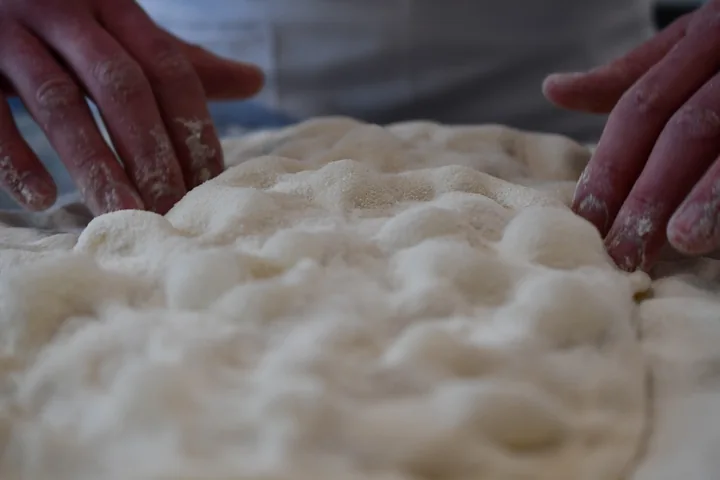
When I take a pinsa dough with 80% hydration out of the bowl, I expect it to stick a little to my fingers. But I know my recipe. If today, with the same flour and water as yesterday, I struggle to even pick it up, before throwing more flour into the bowl I check the salt bowl. Sometimes it's still full.
Salt gives the gluten mesh its strength. Basically, when you lift a flap of dough and fold it over, you feel the dough follow you. Without salt, the same dough tends to be more yielding and sticky. It's this difference I want you to experience at the counter. If this happens to you often, even with the right weights, I'll tell you how to distinguish a hydrated dough from one that has lost its structure.

Why do pizza doughs come out quicker without salt?
Let's say you've organized the dough for the evening service. You've measured out the yeast, chosen when to take out the boxes, and know roughly what time to start rolling out. Salt is also part of that calculation: it slows down the yeast's activity. If you remove it and leave the same amount of yeast and temperature, fermentation tends to speed up.
The problem, at a pizzeria, is opening the box and finding the dough you need in two hours already ready. And the volume alone can deceive you: yeast can produce gas quickly even when the dough has little strength to hold it. See how much the dough has expanded and feel how it reacts when you pick it up.
How much salt should you add to a kilo of flour?
In our pizza and pinsa recipes, we use between 1.5 and 3% salt based on the weight of the flour. If you tell me "I use 2%," that's 20 grams of salt per kilo of flour. Whether you knead with 650 or 800 grams of water, those 20 grams remain the same.
| Salt on the flour | For 1 kg of flour | For 10 kg of flour |
|---|---|---|
| 1,5% | 15 g | 150 g |
| 2% | 20 g | 200 g |
| 2,5% | 25 g | 250 g |
| 3% | 30 g | 300 g |
At 4%, you're already at 40 grams per kilo. Ideally, taste that base along with pecorino and guanciale and you'll immediately understand the first problem. The second is evident during leavening: a high dose of salt can significantly slow down the yeast. 4% isn't a switch that suddenly turns it off.
And what about bland Tuscan bread?
Pane Toscano DOP is made without salt. If you want to try a low-salt dough, 0.7% is equivalent to 7 grams per kilo of flour. It's a different experiment: those 7 grams are there and someone can taste them. There's no 1% threshold below which salt disappears for everyone.
You forgot the salt: when can you still add it?
If the dough is still in the bowl and you find the weighed salt on the table, you can recover it. Start the mixer on low, add it a little at a time, and stop as soon as it's distributed. If you notice it the next day, adding it now won't reverse the fermentation. Open a box and try rolling out and baking a loaf before deciding how to use the rest.
If you really want to understand what those few grams do, next time make two small batches of dough with the same flour, the same water, and the same yeast. For half a kilo of flour, add 10 grams of salt to the first batch and zero to the second. Keep them at the same temperature. Before baking, try lifting both from the counter. Then tell me if you needed to taste the pizza to recognize the one without salt.
All articles