

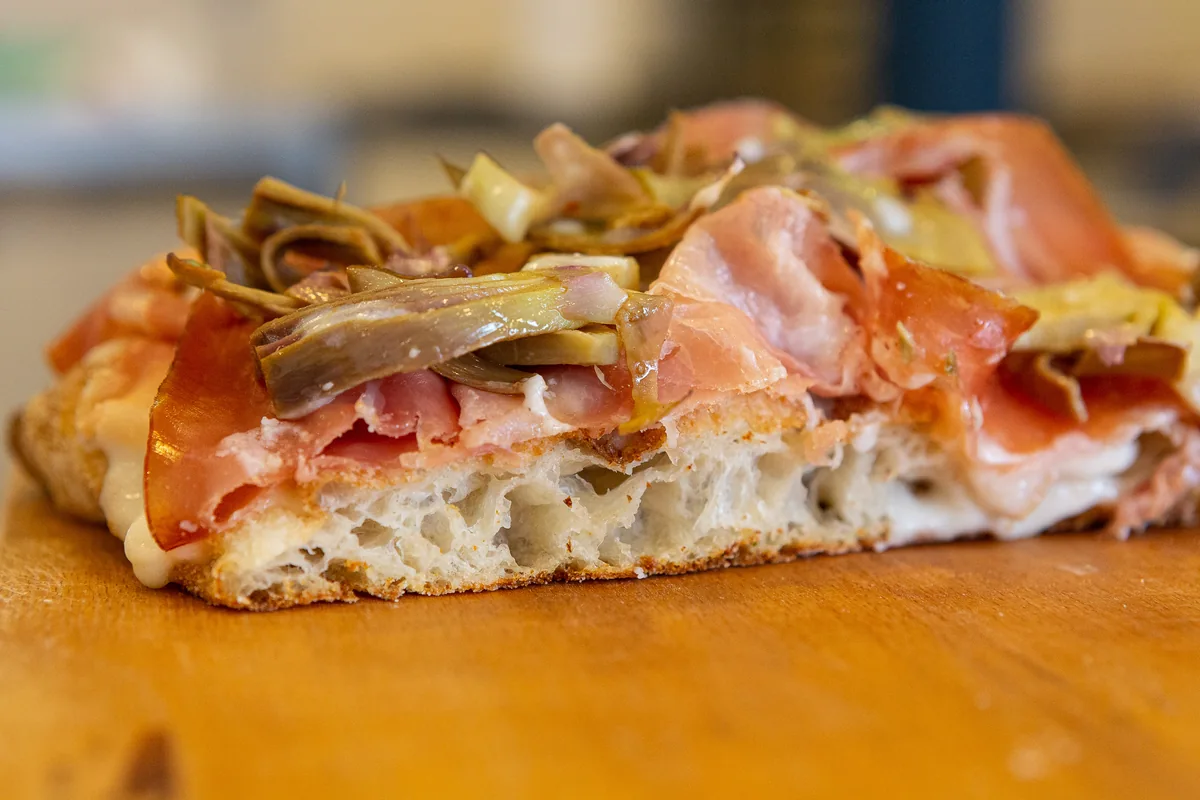
When a pan pizza isn't crispy, the first thing I hear is, "I need to change the dough."
Before changing the recipe, I'd look at how it was made. What condition was it in when you rolled it out? How much topping did you add? How did you manage the oven?
The same dough can produce very different results. You can get a pizza with a nice crispy base or a chewy pizza that folds as soon as you pick it up. To understand where to change, you need to retrace the steps, from rolling it out to the countertop.
In this article
- Cold and poorly risen dough: the problem can start before the oven
- Too much topping: all that water needs to drain out
- An oven that's too high browns the pizza before it's cooked properly
- Many trays at once change the oven's behavior
- Can more water in the dough improve crispiness?
- Crispyness can also be lost after baking
- Where to start to fix a soft pizza
Cold and poorly risen dough: the problem can start before the oven
One of the mistakes I encounter is rolling out dough that's still too cold, underdeveloped, and lacking air. You bring it to the counter because you need to work, but it's not ready.
It resists under your hands, struggling to stretch. You insist, you press it down, and you try to guide it to the corners of the pan. You might eventually get there, but you've already compromised part of the result.
During baking, an underdeveloped structure can remain compact and give that rubbery sensation that makes the pizza difficult to chew.
The solution is to organize your work so that you roll out a ready dough, evaluating temperature, leavening, and relaxation. The time out of the refrigerator must be related to the size, the temperature of the workshop, and the condition of the dough: setting the same timer every day isn't enough.
When I teach, I want the student to learn to observe what's in front of them. A clock is useful, but it can't make decisions for you.
Why does pizza shrink in the pan?
Often, the same dough that struggles to stretch also tends to shrink. You place it in the corners and soon afterward you find it narrower, with a few centimeters of uncovered pan along the edges.
Cold dough, still tough, or not sufficiently relaxed can behave this way. Overworking it while rolling out can also increase the tension.
Continuing to stretch it doesn't solve the problem. If the dough resists, stop, let it rest covered, and reevaluate the rolling. For subsequent productions, correct your handling before reaching the counter.
That shrinkage isn't just unsightly: when it's accompanied by a poorly developed structure, you often find the problem even when you bite into it.
Too much topping: all that water needs to drain out
You can have a great dough and still have trouble with what you put on top.
Tomato sauce that's too watery, mozzarella that hasn't been drained, vegetables that release liquid, an excessive layer of topping: all contribute to making it harder for the pizza to dry out.
A rich pizza must be thought out. The quantity of ingredients and their preparation are part of the cooking process, even if they happen before baking.
To solve this problem, work on the line: drain the ingredients that need it, prepare the vegetables according to their use, and distribute the toppings evenly. Decide which elements need to cook on the pizza and which ones should be added later.
If a simple crust turns out well and a heavily topped one remains moist, you already have a useful indication of where to look.

An oven that's too high browns the pizza before it's cooked properly
Another mistake is thinking that increasing the temperature will automatically make it crispier.
The pizza browns immediately, the top seems ready, and you are forced to take it out. Inside, however, the crumb is still too moist. You reached the desired color before the baking time was complete.
A colorful pizza isn't necessarily a well-cooked pizza.
You need to find the right balance between temperature, time, pizza thickness, and toppings. In a professional oven, how you distribute the heat between the top and bottom also matters.
If the surface darkens too quickly, correct the setting that's causing it to run too fast. The goal is to give the pizza time to cook and dry, without burning the outside.
Look at the bottom, observe the crumb, and taste the product. The surface color alone only tells part of the story.
Many trays at once change the oven's behavior
Then there are situations where the temperature setting is just right, but the result still changes.
Pizza comes out well with a pan. As the oven fills, it becomes softer.
Each pizza releases steam. Baking so many trays at once increases the humidity in the oven and also puts more strain on its heat recovery capacity.
In ovens with an exhaust valve, keeping it closed can hinder drying during the stages when steam needs to be released. The valve must be managed according to the oven and the cooking process: it deserves the same attention as the temperature.
If the problem appears especially when fully loaded, check these aspects before rewriting the recipe. Try using fewer trays, observe the oven's recovery, and check the steam exhaust management.
Can more water in the dough improve crispiness?
It seems like a paradox: we want a crispy pizza and we work with a lot of water.
Yet, in Roman pan pizza dough, high hydration can help achieve a light, open crumb when the flour, kneading, leavening, and cooking are well managed.
I explain it by imagining air chambers between the toppings and the base. It's a useful image to understand how important the internal structure is: a compact crumb and a well-developed one behave differently.
Moisture, however, can move from the toppings and crumb to the crust, even in a very airy pizza. Air pockets don't make the base waterproof.
The advantage isn't simply adding water: it's building a good structure and then being able to cook it properly. If you increase the hydration without adapting the rest of the process, you risk simply finding yourself with more moisture to manage.
This is why I wouldn't choose a water percentage just because I saw it written in a recipe.

Crispyness can also be lost after baking
You made the dough well, you seasoned it well, and you cooked it well. Then you let the pizza retain its steam, and the bottom softens.
Cooling is part of the process. When you need to cool a crust, a rack allows the steam to escape from underneath. Stacking hot products or closing them immediately hinders this process. I also discuss this in the guide to pre-cooking pan pizza and cooling crusts..
Even the management of the counter and the heating system for service must be consistent with the product you want to sell. A pizza should be evaluated in the condition in which the customer will eat it, not just in the first few seconds after it comes out of the oven.
It's the same reasoning I use when organizing the bases and finishing touches for a busy service, as I explain in the article on how to organize a pizzeria by the slice with the rack method.
Where to start to fix a soft pizza
When something isn't working, change one thing at a time.
Start with ready-to-roll dough, use a simple and controlled topping, and cook with an oven load you can handle. Observe the base, open a slice, and taste it even after cooling and reheating.
Then compare the result with your usual production. So you can understand if the problem stems from the dough, the toppings, the oven, or what happens afterward.
This is what I want to teach during the Roman Pan Pizza course in Rome: recognize the signs and know where to intervene. Because in the lab, conditions change, and you need to be able to make pizza turn out well even when the day changes.
All articles